Your site is talking
to Google.
It's saying the
wrong things.
An SEO & Generative Engine Optimization proposal.
You've built something real.
These are advantages money can't buy.
Strong business. Strong reviews. But Google is reading a different story.
Everything here is built
on evidence, not assumptions.
We read your source code line by line. We verified every finding against the live site. We ran a full-site audit on April 7, 2026 that surfaced 36 distinct issues across 117 crawled pages. We tested your target keywords against every competitor ranking above you. And we documented your presence, and absence, across every major review platform, directory, and AI search engine.
What we found is a business with real advantages. But the layer between your business and the customers searching for it has cracks. And those cracks are costing you bookings every day.
This proposal covers four dimensions of search visibility: On-Site SEO, Technical SEO, Off-Site SEO, and Generative Engine Optimization (GEO). For each, we explain what we found, what it means for your business, and exactly how we'll fix it.
For definitions of any technical terms, visit the Acta AI SEO & GEO Glossary.
Google can see your site.
Here's what it actually reads.
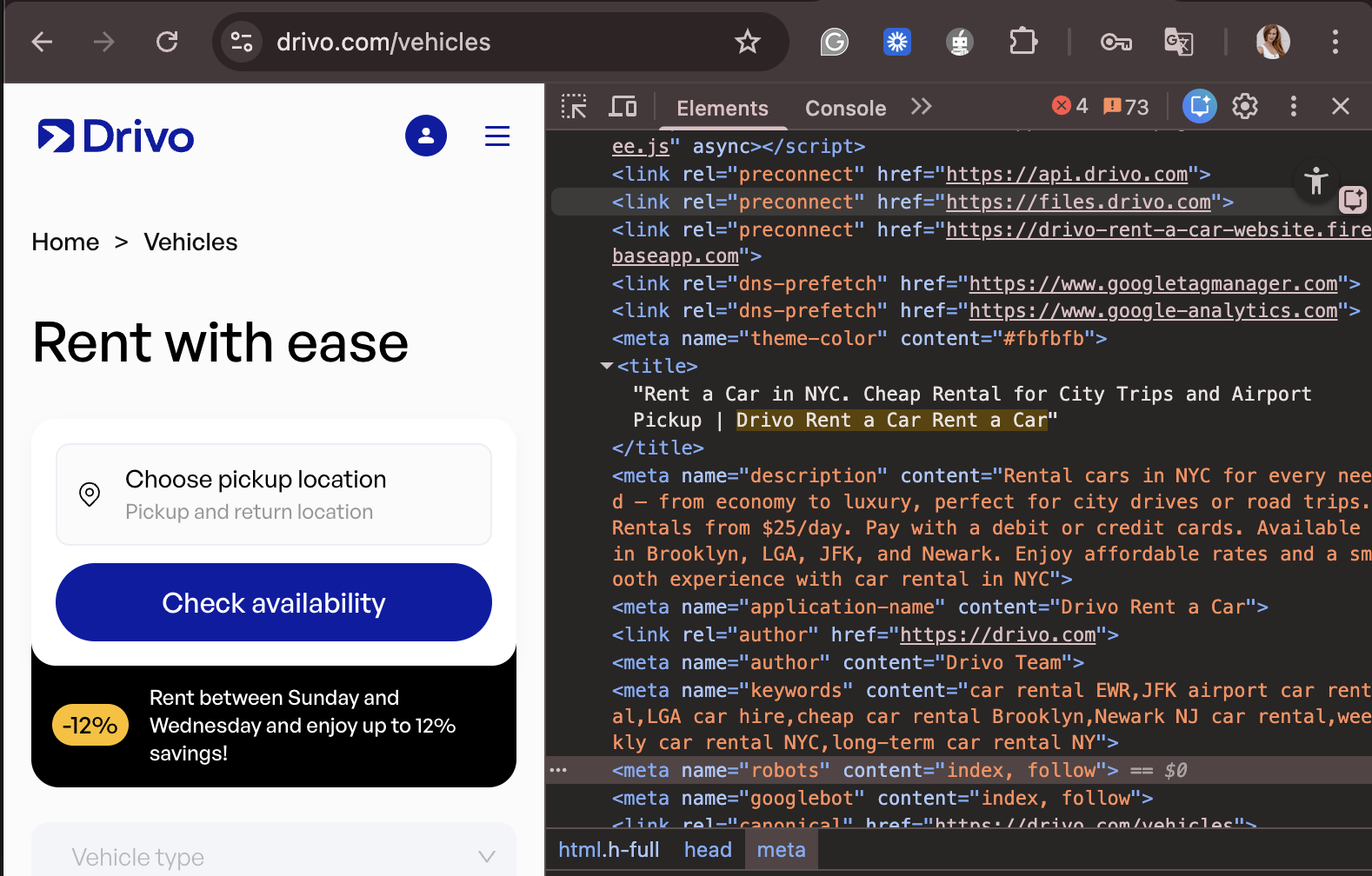
Wrong titles. Broken schema links. Boilerplate descriptions. Google can see your site, but it can't trust what it reads.
The numbers behind the score.
Full-site crawl and manual verification, April 7, 2026.
| What we measured | What we found |
|---|---|
| Overall SEO Health Score | 47 / 100 |
| Issues found across the site | 36 distinct issues across 117 crawled pages |
| Pages where Google cuts off your title in search results | 81 of 117 (69%). Title tags exceed 60 characters |
| Pages where Google can't display your full description | 98 of 117 (84%). Meta descriptions exceed 155 characters |
| Pages sharing the same title as another page | 8 duplicate titles |
| Pages with very little content (under 200 words) | 8 thin content pages |
| Pages with no link from your homepage | 152 of 187 orphaned |
| Broken links in your vehicle listing structured data | 89, all pointing to /vehicles/undefined |
| Visibility in AI search (ChatGPT, Perplexity, Google AIO, Bing Copilot) | 0. Drivo does not appear for any tested car rental query |
A foothold on page 1.
But invisible where it matters most.
Approximate positions based on manual search testing on April 7, 2026. Authoritative rank tracking with position history will be established once we have Google Search Console access as part of the engagement.
| What people search | Where Drivo shows up | Who's above you |
|---|---|---|
| "car rental JFK airport" | ~#9, bottom of page 1 | Enterprise, KAYAK, Avis, Sixt, Cheapflights, Budget, Alamo, Payless |
| "car rental NYC" | ~#6 on page 1 | KAYAK, Enterprise, Avis, Zipcar, Budget |
| "rent a car Brooklyn NY" | ~#8 on page 1 | KAYAK, Enterprise, Avis, Hertz, BrklynRentals, Sixt, Budget |
| "car rental Newark EWR" | Not on page 1 | Despite EWR being your highest-reviewed location (1,042 Yelp reviews) |
| "van rental NYC 12 passenger" | Not on page 1 | Despite this being a service Drivo offers and wants to grow |
You have a foothold on page 1 for several terms. But you're invisible for your busiest location (Newark) and one of your key growth segments (passenger vans). Every day those gaps remain is direct booking revenue going to competitors or aggregators.
On-Site SEO
What your pages communicate to the humans reading them and the search engines ranking them.
Your pages exist, but most of them are making a poor first impression in search results. Titles are getting cut off, descriptions are too long to display, your homepage doesn't mention car rental or NYC in its main heading, and more than 80% of your pages have no connection to your homepage, which means Google treats them as low-priority. Fixing this is the fastest path to more clicks and more direct bookings from the traffic you're already close to capturing.
What we found
Your search results are getting cut off.
81 of your pages have title tags that exceed 60 characters, which is the point where Google truncates them. That means your brand name, your location, or your key selling point is getting chopped off in the very place customers decide whether to click. Similarly, 98 pages have meta descriptions exceeding 155 characters, so nearly half of each description is invisible to searchers.
Some pages are competing with each other.
8 pages share identical titles, including your About page and your Economy Car page displaying the exact same title. When Google sees two pages claiming to be about the same thing, it often suppresses both rather than choosing one. That means neither page is performing at its potential.
Your homepage isn't telling Google what you do.
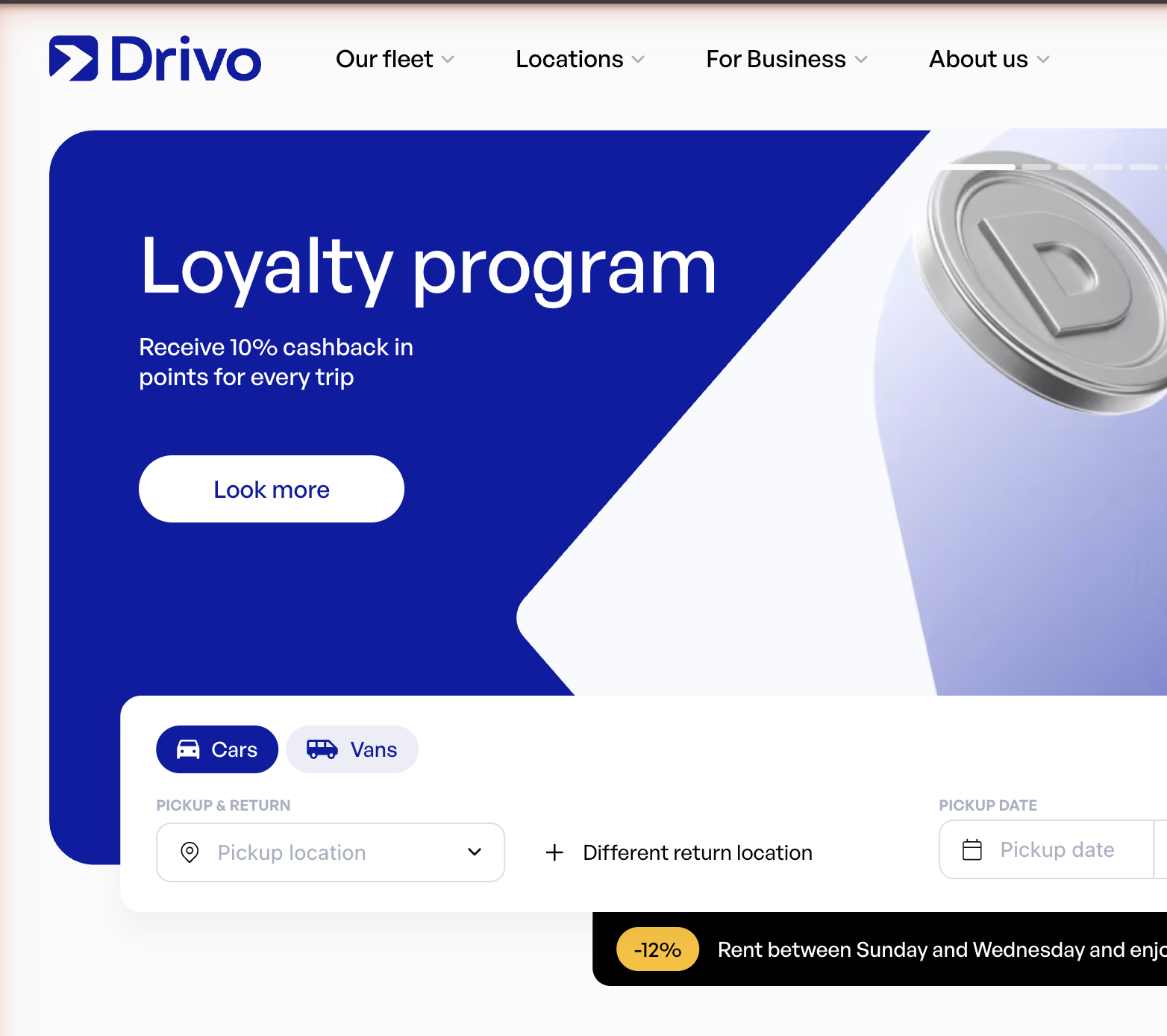
The main heading on your homepage is "Rent with ease." It contains no mention of car rental, NYC, JFK, Brooklyn, or any term a customer would actually search for. Google uses your main heading as one of its strongest signals for what a page is about. Right now, that signal is empty.
The word "cheap" is prominent in several titles.
While it targets a real search term, "cheap" carries a quality connotation that works against the trust signals Google is looking for, especially for a newer brand without the authority buffer that Budget or Hertz have. "Affordable" communicates the same price advantage without the baggage.
Spelling errors on live pages.
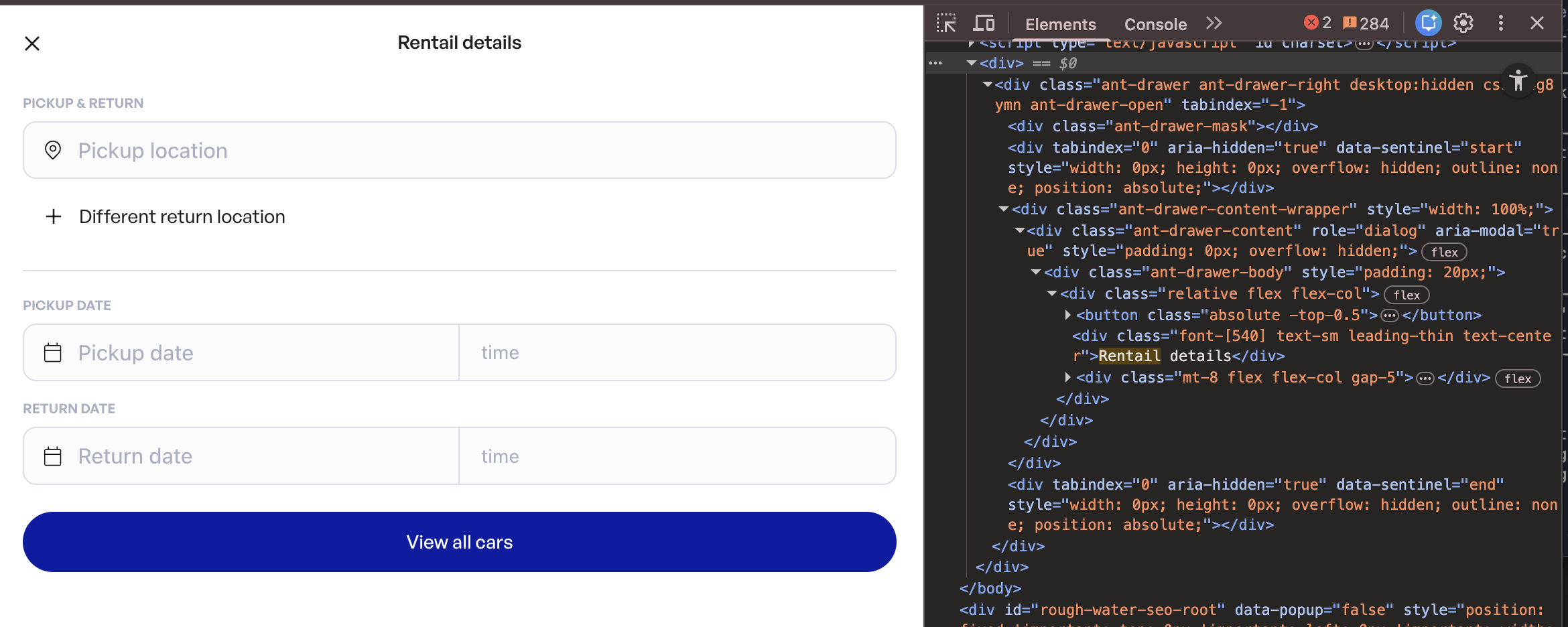
"Rentail details" in the booking drawer. "Recieve 10% cashback" on the loyalty page. "Look more" where "Learn more" should be. On their own, these don't tank your rankings. But Google's quality guidelines specifically ask: "Does the content have any spelling or stylistic issues?" When Google sees these alongside other problems, they form a pattern.
152 of your 187 pages have no link from the homepage.
Your brand pages, vehicle model pages, and vehicle category pages are essentially invisible to Google because no internal links connect them to your most authoritative page. Think of your homepage as the front door of a building. Right now, 152 of your rooms have no hallway leading to them. Google can find them through other paths, but it treats them as far less important.
100% of your pages have links with no descriptive text.
When a link says "click here" or has no text at all, Google can't understand what the linked page is about. That's 117 pages of missed context.
Technical SEO
What your code communicates to search engine crawlers.
Your site's architecture is sound, but the data it's sending to Google has bugs that are actively hurting your credibility. Google is following 89 links in your vehicle listings that lead nowhere. Your blog is invisible because a single line of code is pointing Google to the wrong page. And test data (including a vehicle listed at 2,222 MPG) is sitting in the information Google reads about your business. These aren't things your customers see. They're things Google sees, and they shape how much Google trusts your site.
What we found
Your vehicle listings are sending Google to dead ends.
Every one of your 17 brand pages (Toyota, Honda, Kia, and so on) contains structured data, the information layer that tells Google what vehicles you offer. But every car link in that data points to a page called /vehicles/undefined, a page that doesn't exist. That's 89 broken links, across every brand page, that Google hits every time it crawls your site. Each time, it records that your vehicle data is unreliable.
Test data is live in production.
A Ram ProMaster listing contains keyboard-mash gibberish ("fdsf", "dsfsd") in its description, test data that was never cleaned up. A vehicle called "Over Size Suv" is listed at 2,222 MPG with a blank description. Your 12-passenger Sprinter van description claims a seating capacity of 15, a copy-paste error from a different listing. Google reads all of this.
Your blog is being hidden from Google.
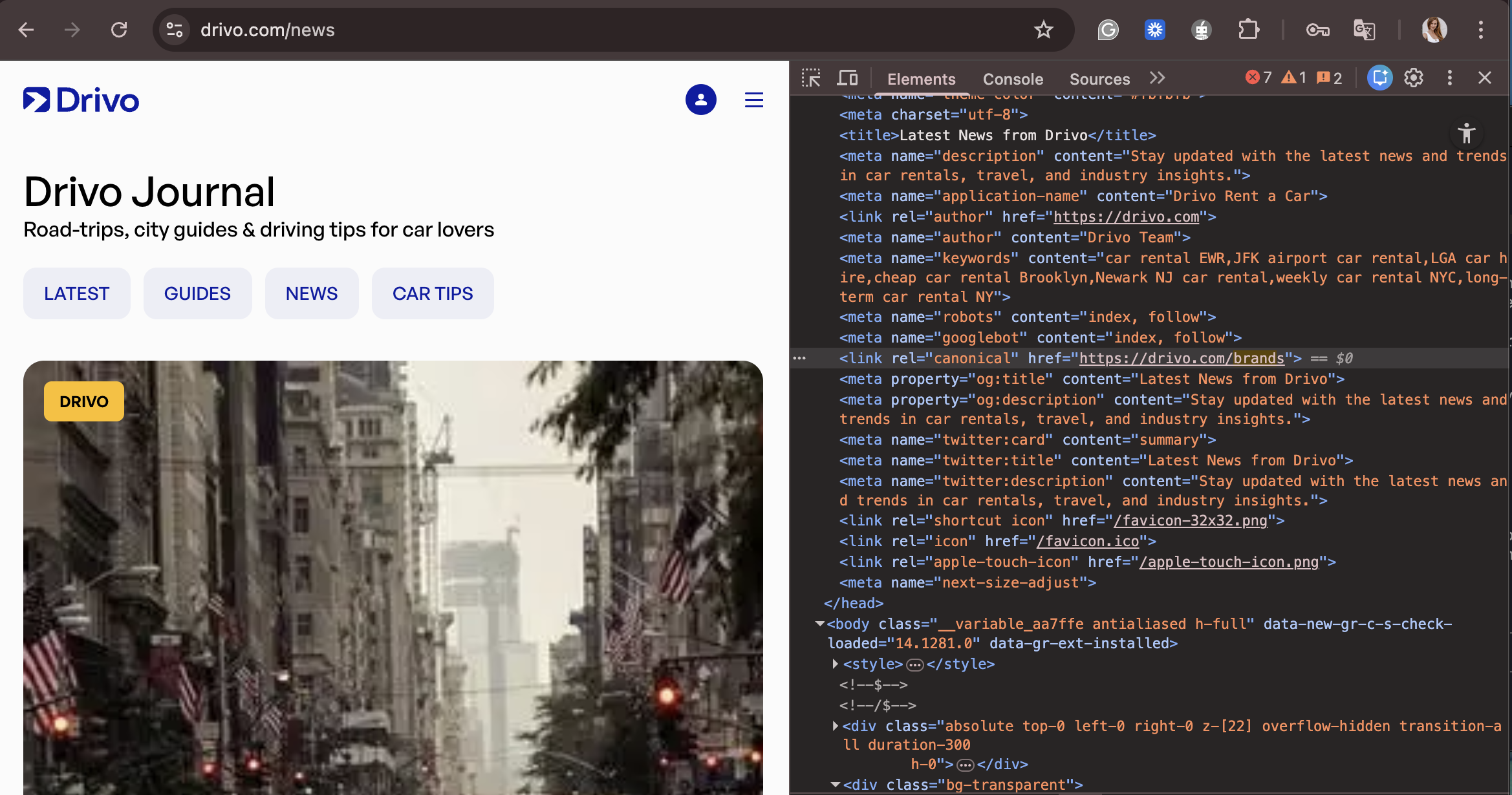
The /news page, where all your travel guides and blog content live, has a canonical tag that points to the /brands page instead of itself. This single line of code tells Google: "Ignore this page. It's a duplicate of the brands page." Every blog post your team has published, every hour spent on content, Google is being told to skip it.
Empty FAQ wrappers on model pages.
Several vehicle model pages have an FAQ section in their code with zero questions inside it. Google's guidelines say: "Don't create blank or empty pages just to hold structured data." This signals low quality.
"Vehicle not found" pages pretending to be real.
Pages like /vehicles/over-size-suv show "Vehicle not found" to visitors but return a success code to Google. These "soft 404s" waste Google's limited attention on your site and associate low-quality signals with your domain.
Old "Ace" branded pages are still live and visible to Google.
Feedback pages referencing the Ace brand name exist at every location URL and are marked as indexable. Google discovering these creates confusion about who Drivo actually is.
Location URLs break if anyone uses lowercase.
/locations/EWR works. /locations/ewr returns an error. Any external link, any backlink, any search engine entry using lowercase will fail.
Seven issues. One pattern.
Here are the seven that matter most (the pattern behind the other 29). Click any issue to see the evidence.
Meta tags are wrong across the site
Structured data sends Google broken links
/vehicles/undefined. That's 89 broken URLs across all 17 brand pages. Google follows these, hits dead ends, and learns your structured data isn't reliable. Some model pages output empty FAQ schemas with zero questions. Google says: "It is more important to supply fewer but accurate properties rather than badly-formed or inaccurate data." Source: Google Search Central, Structured Data Guidelines
Your blog is invisible to Google
Test data and typos are live on your site
fdsf, dsfsd, sdfs) visible to customers and in the structured data Google reads. One vehicle is listed at 2,222 MPG. Your booking drawer says "Rentail details" instead of "Rental details." The loyalty page says "Recieve" instead of "Receive." These aren't hidden in code. They're on the live site, and Google reads every one of them. Google Quality Rater Guidelines: "Does the content have any spelling or stylistic issues?"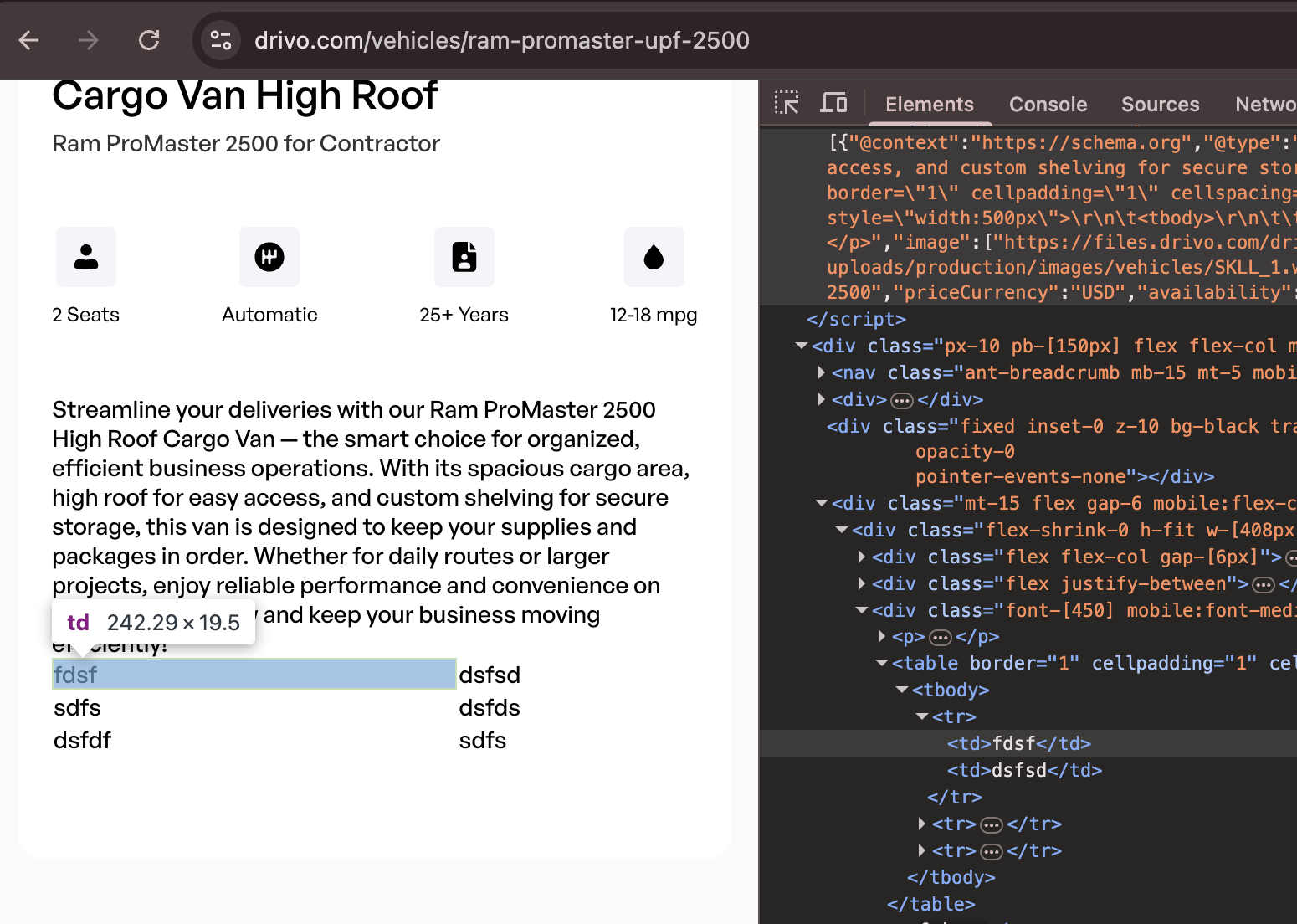
152 pages orphaned from the homepage
Content is thin, stale, and on autopilot
AI search has nothing to cite
These issues don't exist in isolation.
They reinforce each other.
Google builds a trust profile of your entire domain. Every crawl, it reads these signals together.
of your sitemap pages have zero links from the homepage
152 of 187 pages. That's every brand page, every car model, every vehicle category. These are the pages most likely to match what a customer is searching for. Google can find them eventually through the sitemap, but without homepage links, zero link equity flows to them. They compete with nothing behind them.
blog posts Google may be indexing correctly
Your /news canonical tag tells Google that page is actually /brands. The blog is the only part of your site producing fresh content: guides, car tips, travel advice. A single wrong tag may be telling Google to ignore all of it. Every new post you publish lands on a page Google thinks is a duplicate.
dead-end URLs Google follows every time it crawls your brand pages
Each crawl, Google's bot follows 89 links in your structured data to /vehicles/undefined. Each time, it hits a dead end. Each time, it records that your schema isn't reliable. Once Google stops trusting structured data, it stops showing rich results, the enhanced listings with ratings and availability that drive clicks over plain blue links.
times Drivo appears when AI is asked about car rentals near JFK
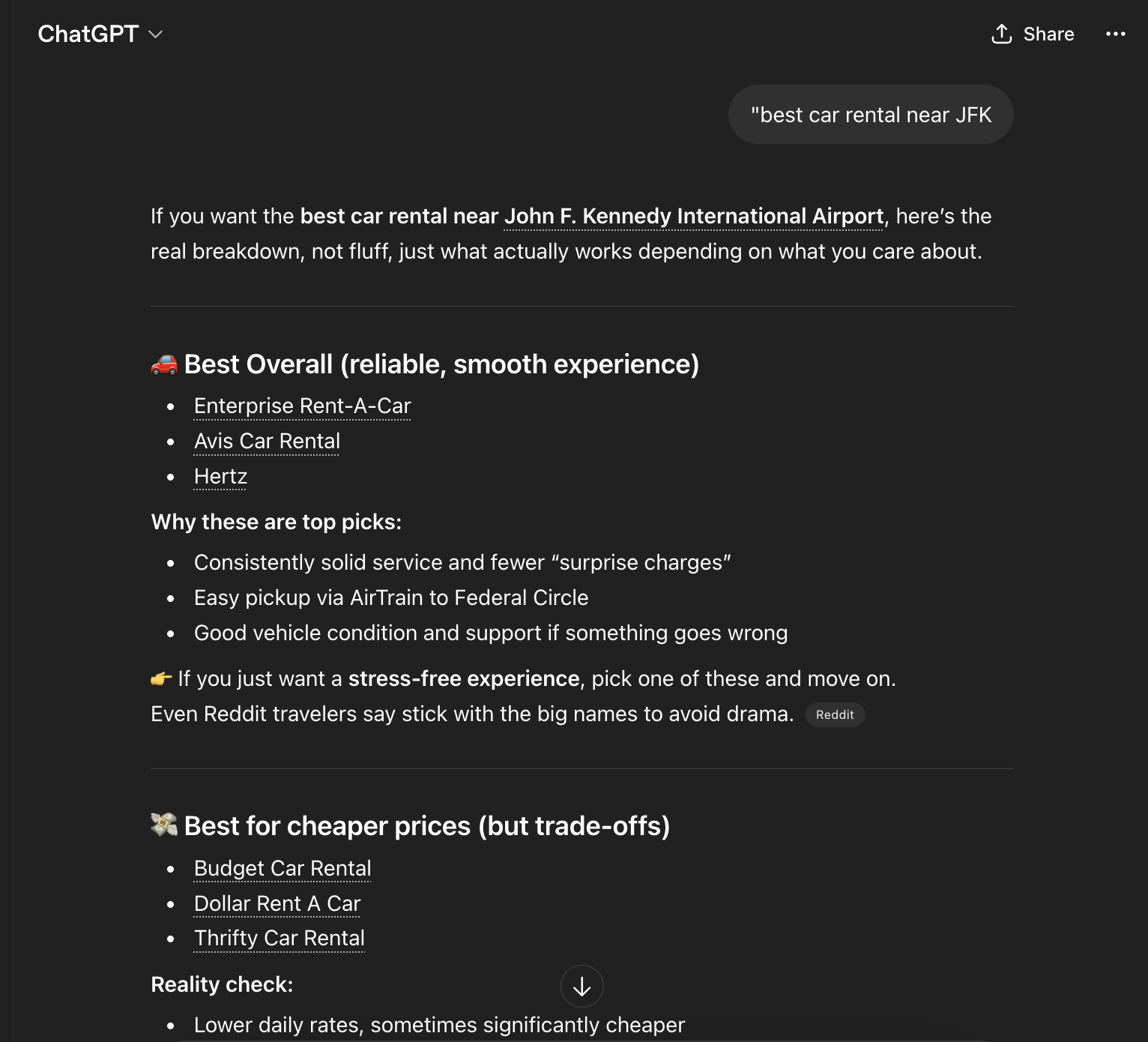
We tested ChatGPT and Perplexity. Enterprise, Avis, Hertz, Budget were all cited. Drivo was absent. Not because AI can't reach your site, but because there's nothing structured enough to quote. Every day this stays the same, AI systems reinforce their answers without you in them.
None of this is modeled or estimated. Every number above comes from your live site's source code and real search results, verified on April 2, 2026. The issue isn't any single bug. It's that Google reads all of them at once and forms one conclusion about your site's reliability.
Off-Site SEO
What the rest of the internet says about Drivo.
Google doesn't just evaluate your website. It evaluates what the rest of the internet says about you: your reviews, your directory listings, your backlinks, and whether you exist as a recognized entity in the databases that feed search engines and AI platforms. You have strong review volume on Yelp, but significant gaps elsewhere. You have no Wikipedia page, no Wikidata entity, and no Google Knowledge Panel. Budget, Hertz, and Enterprise have all three. Your BBB profile has unresolved complaints actively working against the trust your on-site SEO is trying to build. Closing these gaps is how a local independent starts being treated like a recognized brand.
Google can't walk into your store.
It can't see the fleet, meet the staff, or watch a customer drive off happy. It has to infer trust from signals, and Drivo isn't sending them.
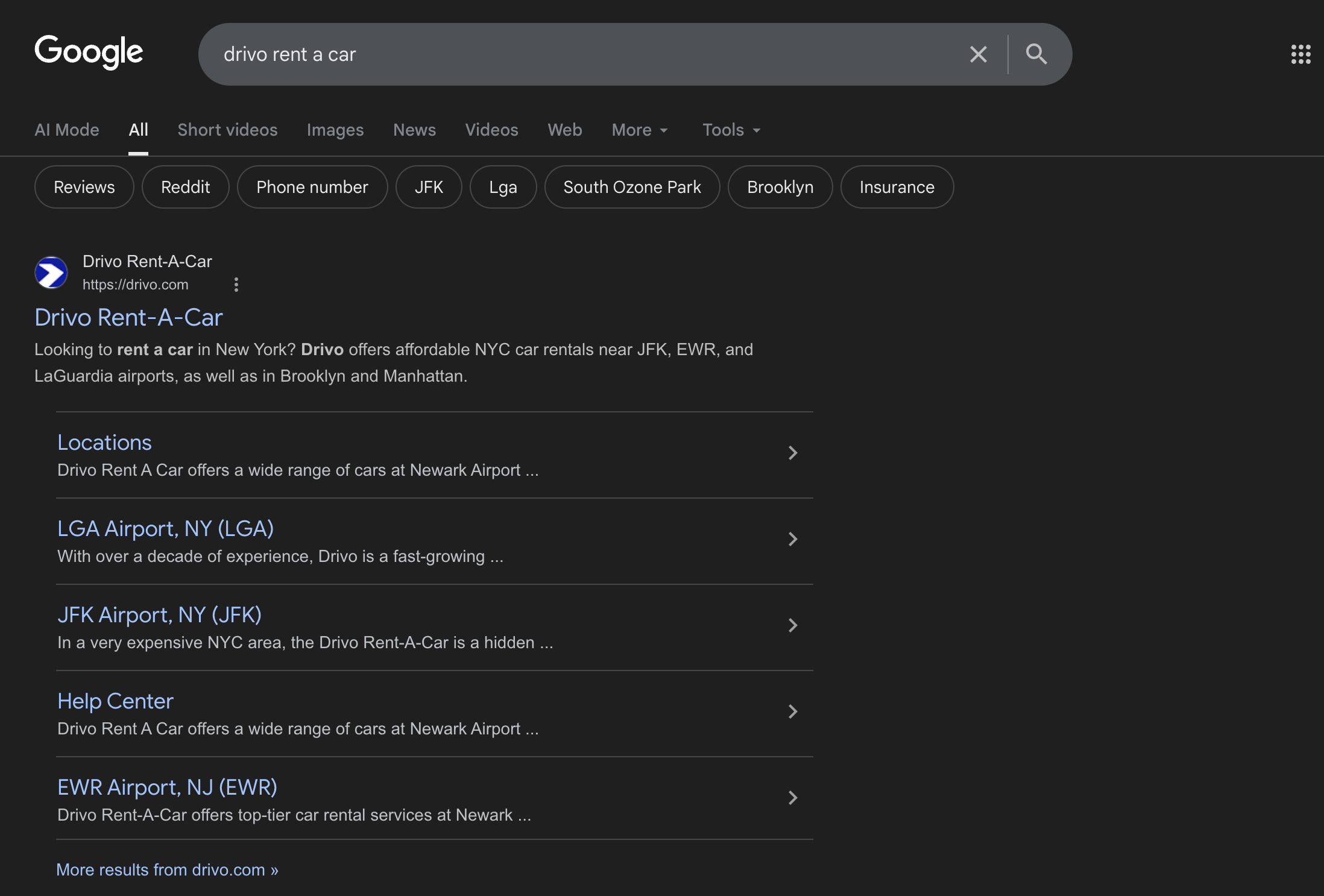
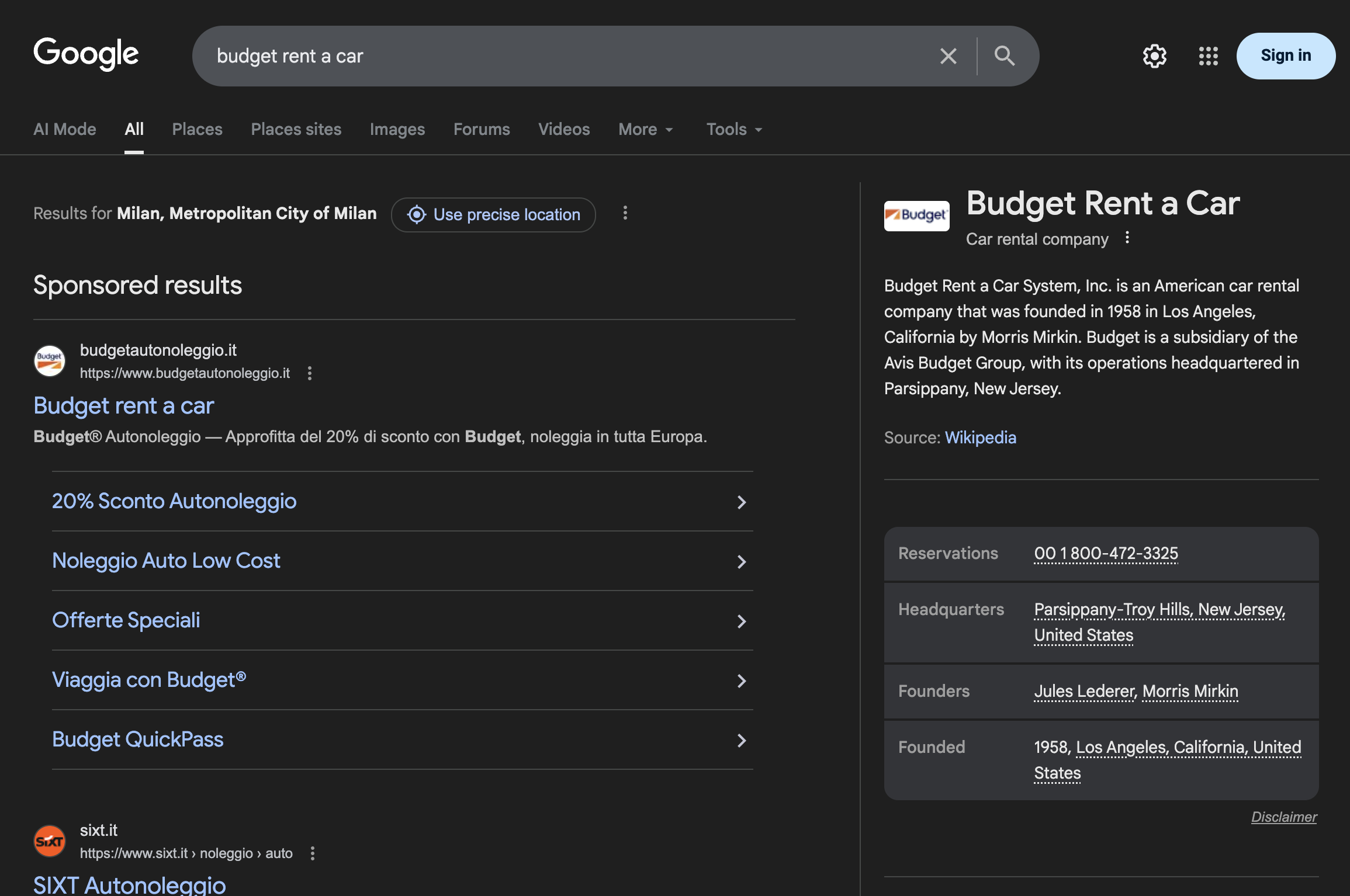
Budget can survive sloppy metadata because it has layers of authority cushioning it. Drivo doesn't have that buffer. Every technical issue we just showed you is the loudest thing Google hears.
Strong review volume.
A solid starting point.
| Platform | Status |
|---|---|
| Yelp (EWR, Newark) | 1,042 reviews, your strongest platform |
| Yelp (JFK) | 359 reviews |
| Yelp (Brooklyn, Coney Island) | 87 reviews |
| Yelp (Brooklyn, Dumbo) | ~50 reviews |
| Trustpilot | 600+ reviews across multiple location pages |
| TripAdvisor | Active profile |
| BBB | Profile has unresolved complaints affecting trust score |
| 11K followers, 573 posts, active | |
| 1,400 followers | |
| 3,000 followers | |
| Crunchbase | Basic profile |
| KAYAK, Cheapflights, EconomyBookings | Listed as rental partner |
The gaps cushioning your competitors.
| Platform | Why it matters for bookings |
|---|---|
| Wikipedia | No page. This is the single strongest authority signal for being recognized as a notable business by both Google and AI platforms. Every major competitor has one. |
| Wikidata | No entity. This is the database that feeds Google's Knowledge Graph and the knowledge bases behind ChatGPT, Perplexity, and other AI tools. Without it, you don't exist in their reference material. |
| Google Knowledge Panel | Doesn't exist. When someone searches "Drivo Rent a Car," there's no panel. Budget gets a full panel. So does Enterprise. Drivo gets nothing. |
| Apple Business Connect | Likely unclaimed. This is what powers Siri and Apple Maps when people ask for car rentals. |
| Bing Places | Likely unclaimed. This is what powers Bing Copilot recommendations. |
| YouTube | No branded channel, missing an opportunity to show up in video results for airport pickup guides, fleet tours, and NYC driving tips. |
| Local Chambers of Commerce | Not found in Newark, Brooklyn, or Queens chambers, which would yield easy backlinks and local authority signals. |
| Travel directories & NYC tourism sites | No presence on major travel platforms or airport guide content. |
Generative Engine Optimization
How AI platforms find, understand, and recommend your business.
When someone asks ChatGPT, Perplexity, or Google's AI Overviews "Where should I rent a car near JFK?", Enterprise, Avis, Hertz, and Budget appear. Drivo does not. This is the fastest-growing channel for how people discover services, and you're completely absent from it. Most agencies aren't addressing this yet. We are, and this is where Drivo can leapfrog competitors still optimizing only for traditional search.
GEO: Generative Engine Optimization
When someone asks an AI "What's the best car rental near JFK?", you need to be in the answer. Right now, you're not.
Click any platform to see what your score means.
No other agency pitching you is offering GEO. This is where Drivo leapfrogs competitors still doing SEO the old way.
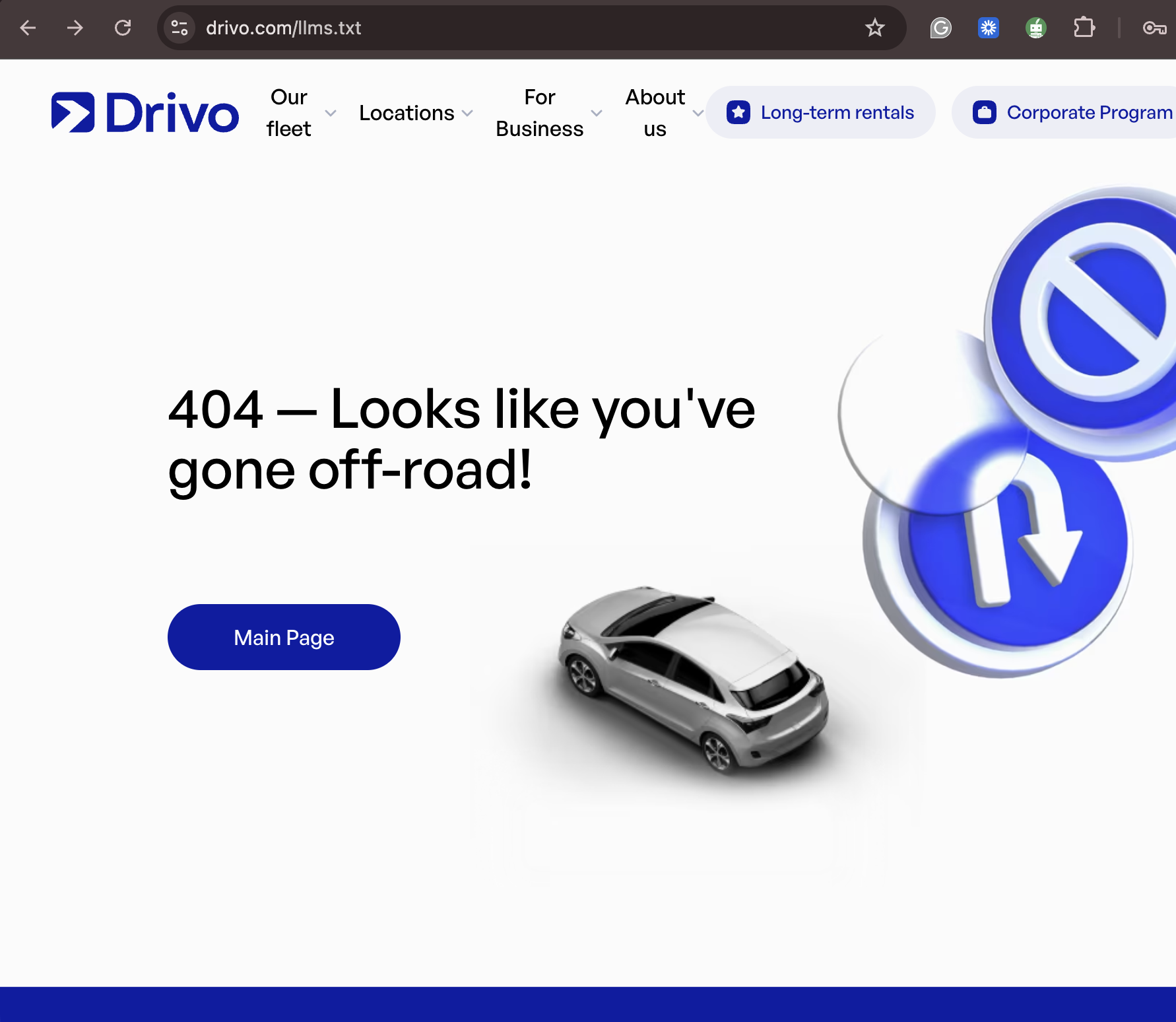
The file you said was live
returns a 404.
On our April 3 call, your team mentioned that an llms.txt file had been implemented. As of April 7, drivo.com/llms.txt returns a 404 page. It is also not referenced in your sitemap.
This is a small detail, but it illustrates a broader point: the gap between planning and verified execution is where visibility gets lost. Our role is to close that gap.
Every month you wait,
you pay twice.
Once in ad spend, buying back traffic you should own. Every organic booking lost to broken schema and thin content becomes one you have to recapture through Google Ads, Meta, or an OTA commission. Airport car rental is one of the most expensive paid keyword categories in travel. The bill adds up fast.
And once in compounded cleanup costs when you finally do fix it. Every new vehicle page, every new location, every new blog post shipped on the current foundation inherits the same template bugs. The pile grows. The cleanup bill grows with it.
And AI search is not waiting for you to decide. ChatGPT, Perplexity, and Google AI Overviews are already picking who gets cited for "car rental near JFK" today. Every month Drivo is absent, a competitor gets entrenched as the default answer. That window does not stay open.
Time to tell it
right.
Let Google read the real story of what Drivo has to offer.
We talked about
your goals.
The right plan depends on what success looks like for Drivo.
More direct bookings?
We prioritize conversion-focused pages and booking funnel optimization.
Reduce aggregator dependency?
We rank for keywords that currently send traffic to KAYAK and Skyscanner instead of you.
Grow the business van segment?
We build targeted B2B content and LinkedIn-ready landing pages for fleet managers.
Specific locations underperforming?
We prioritize those location pages with hyper-local SEO and content.
Fix. Optimize. Grow.
- Meta tag audit & rewrite
- Schema bug fixes (89 broken URLs)
- Internal linking architecture
- Content depth audit
- Unique copy for every page
- GEO setup & AI readiness
- Schema rebuild & expansion
- Reputation foundation
- Monthly SEO management
- 8 blog posts via Acta AI
- GBP & GEO monitoring
- Reputation building
Agency depth.
Founder attention.
Everything in this proposal (every screenshot, every line of source code, every broken URL) was found and verified before you hired us. That's how we work.
SEO + GEO in one engagement
The GEO scores and AI search analysis you just saw aren't an upsell. They're part of the work. No other agency pitching you is auditing your AI search visibility alongside traditional SEO. We do both because the 2026 search landscape requires it.
We built Acta AI to deliver more at lower cost
8 blog posts per month isn't a stretch goal. It's our standard output. Acta AI, our content platform, produces research-backed, SEO-optimized content at a pace traditional copywriting can't match and at a cost that doesn't require an enterprise budget.
Flat fee, all 5 locations
Per-location pricing is designed for national chains with hundreds of sites. For 5 NYC locations where the work overlaps significantly, a flat fee reflects the actual scope. If you open a 6th location, no surprise invoice.
Findings first, not promises
This proposal contains 7 verified issues, 4 critical. We didn't send a capabilities deck. We showed you what's wrong, with the evidence, and explained exactly how we'd fix it. That's the standard for every engagement.
Every pillar traces back
to what you told us matters.
On our April 3 call, you shared the priorities that matter most to Drivo. Here is how this work maps to each one.
More direct bookings
Every pillar feeds this. On-site improvements make your pages more compelling in search results. Technical fixes let Google properly index your booking-ready pages. Off-site authority pushes you higher. GEO puts you in AI-generated answers. New content targets high-intent queries from people ready to book. Each organic ranking you gain is a customer who comes to drivo.com instead of finding you through an aggregator.
Reducing OTA dependency
When you rank organically for "car rental JFK" and "rent a car Brooklyn," customers arrive at your site directly, with no commission to Expedia, Priceline, or KAYAK. The content strategy specifically targets queries where aggregators currently outrank you, with the goal of capturing that traffic without a middleman.
Growing business van & cargo
You're currently invisible for "van rental NYC 12 passenger." We'll create dedicated, optimized landing pages for passenger van and cargo van rentals, build supporting content (guides for event planners, contractor fleet solutions, church group transportation), and implement vehicle data markup so Google can display your vans with capacity and pricing details in search results.
Improving all locations, especially EWR
Your Newark location has 1,042 Yelp reviews but doesn't appear on page 1 for "car rental Newark EWR." Location-specific optimization (unique content, local data markup, Google Business Profile management, neighborhood-level pages) will address each location individually.
Managing the Ace/Drivo brand
The Ace partnership serves your OTA strategy, and we won't disrupt that channel. But in organic search, brand signals need to be clear. We'll manage the visibility of old Ace-branded pages while preserving the connections that support your OTA business.
SEO and GEO compound.
An honest timeline. You won't see ranking changes on day one. Google needs time to recrawl.
Technical fixes deployed. Priority title and description rewrites live. Baselines established using your analytics data. You will not see ranking changes yet. Google needs time to recrawl.
Google begins processing your corrected pages. Schema fixes start producing richer search results. First content pieces published. AI crawler activity becomes visible in server logs.
Typical organic impression increase: 30-60%
Rankings shift as Google processes the full scope of changes. Blog posts begin capturing long-tail traffic. Google Business Profile improvements increase visibility in local results. AI citations may begin appearing.
Typical organic traffic increase: 50-100%
Content library builds topical authority. Backlink profile strengthens. Review sentiment improves. GEO presence establishes across AI platforms.
Typical organic traffic increase: 100-200%
Strong organic visibility across all 5 locations. Established AI search presence. 48+ blog posts driving consistent traffic. Measurably reduced aggregator dependency.
We don't just do the work.
We prove it worked.
Baseline first. Before we change anything, we document exactly where Drivo stands: keyword positions by cluster, organic traffic by page, Search Console impressions, click-through rates, Google Business Profile metrics by location. This becomes the "before" snapshot. Without it, nobody can prove anything worked.
Monthly reporting. You won't receive a data dump. You'll receive a narrative: here's what changed, here's why, here's what's next. Each report includes organic traffic trends, keyword movement, content performance, Google Business Profile metrics by location, review sentiment, before-versus-after comparisons, and AI visibility tracking across platforms.
Quarterly business reviews. Every quarter, we step back and assess the bigger picture: what's working, what needs adjustment, and how the strategy should evolve.
Pending access to your analytics and Search Console, baselines will be established during the first two weeks. Any metrics in this proposal that depend on data we don't yet have will be validated during the baseline phase.
Let's tell it
right.
Google is ready to hear the real Drivo story.
Confidential. This proposal and its contents are intended solely for Drivo Rent a Car. Pricing is indicative and may be adjusted based on final scope, goals, and requirements discussed during our kickoff engagement.